

Measuring a U-channel paper edge protector is three numbers, and buyers routinely send only one of them. A U profile is specified by inside width, leg length and wall thickness. Send a panel thickness alone and the profile has to be guessed; send all three and it can be made to fit first time. This is how to take those three measurements on a real panel, including the ones already stacked, wrapped or banded.
Each dimension sits in a different place on the part, and confusing any two of them produces a profile that will not fit.
Length is the fourth number, but it is not a fit dimension: it is cut to the edge being protected, from 300 mm up to 6,000 mm on our lines, with longer runs made from segments. Above 260 mm opened across all three faces the piece cannot be folded as one part, so a very thick panel takes two L profiles back to back instead of a stretched U.
The panel is usually not on a bench when the question is asked. It is in a stack, under banding, or already wrapped. That does not prevent an accurate measurement, but it changes the method.
On a stack, measure the outer stack thickness across several positions and divide by the number of panels. Do not measure one panel at the top of the stack: the top sheet is often the least compressed and the least representative. Take the figure at four points along the edge and use the largest, because the profile has to clear the thickest point, not the average.
Under banding, measure between bands, not under one. A band compresses the edge locally and a caliper reading taken on top of it will be low by a millimetre or more, which is exactly the margin a U profile needs.
On a wrapped pallet, cut a window in the wrap rather than measuring through it. Stretch film is typically 20 to 30 microns and will not move a reading much on its own, but two layers plus a corner fold will.
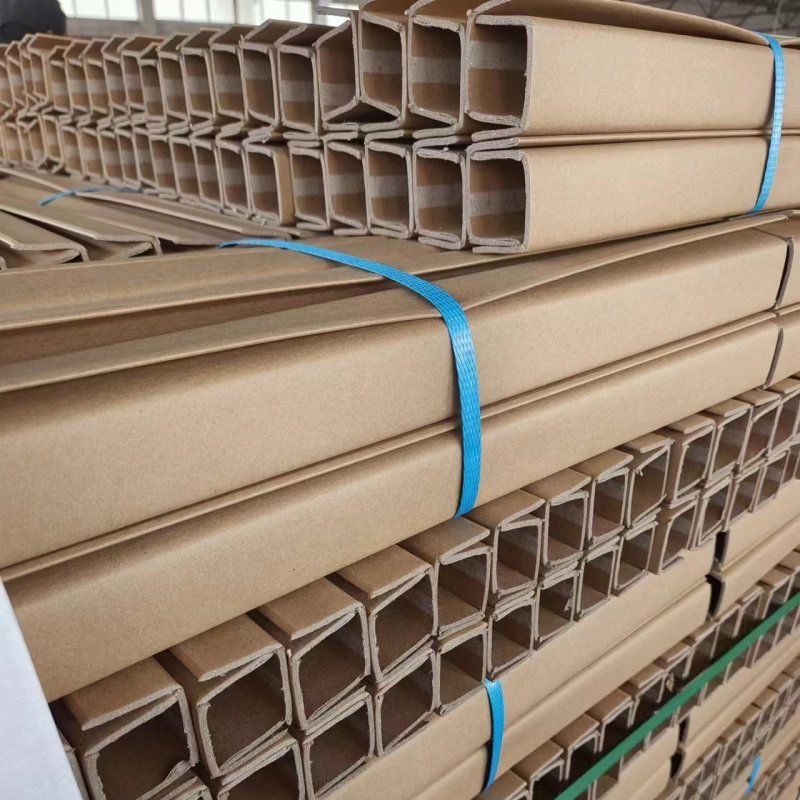
A U profile holds itself on the panel; nothing else keeps it there. That is its advantage over an L profile, and it is entirely dependent on the inside width being right.
The correct fit is light hand pressure. The panel should slide in with one hand and stay where it is put. Two failure modes sit either side of that.
Too tight, and the profile creases at the fold when it is pushed on. The crease is not cosmetic: it becomes the point where the board buckles under a band later, and it is where the profile will split first. A fitter who needs a mallet is telling you the inside width is wrong, not that the panel is difficult.
Too loose, and the profile falls off when the panel is turned, lifted or slid across a bench. At that point it is not protection, it is a component on the floor, and the cost of a lost protector is the same as the cost of no protector plus the labour to chase it.
A symmetrical U assumes both faces need equal cover. In practice one face is usually finished and visible, and the other is hidden against the next panel or carries hardware. Unequal legs let the profile follow the pack instead of forcing the pack to suit the profile.
The measurement rule is that both legs are drawn from the fold line, and the longer leg goes on the face that can be marked. If the panel is not centred in the channel, the fold moves toward the shorter leg, so a drawing that dimensions the legs from the middle will produce a long leg that arrives short.
The symptom usually appears in the first hour of a run, and each one points back to a specific number.
| Symptom on the line | Number that is wrong | What to change |
|---|---|---|
| Profile will not go on by hand | Inside width too small | Re-measure the thickest point of the stack |
| Profile slides off when turned | Inside width too large | Match to the panel, not to the next size up |
| Legs cover the wrong face | Legs quoted from the middle | Draw both legs from the fold |
| Edge still crushes under band | Wall too thin for the load | Step the wall up, keep the width |
| Board creases at the fold | Width tight plus thin wall | Widen slightly and thicken |
| Pieces rock on the deck | Cut length or squareness | Agree the length tolerance |
Only one line in that table is a board problem. The other five are measurement or drawing problems, which is why a photo of the pack at the point of fitting is worth more than a specification sheet.
Once the three numbers are known, the profile follows from them. The table below is the working relationship we use when quoting, not a stock list, because every U we make is folded to the panel thickness rather than to a catalogue size.
| Panel thickness | Inside width | Leg length | Wall |
|---|---|---|---|
| 3-6 mm | 6 mm | 25-40 mm | 2.5-3 mm |
| 10-18 mm | 18 mm | 40-50 mm | 3-4 mm |
| 20-30 mm | 30 mm | 50-60 mm | 4-5 mm |
| 40-50 mm | 50 mm | 60-80 mm | 5 mm |
| Up to 150 mm | 150 mm | 100 mm | 5-8 mm |
Two limits sit outside this table. Inside width runs from 6 mm to 150 mm, so a panel outside that band needs a different construction rather than a bigger profile. And the opened width across all three faces is capped at 260 mm by the folding equipment, which is the constraint that catches wide panels with long legs on both sides.
It should be, within a millimetre or two. The inside width is the panel thickness the profile accepts, so the two numbers move together.
Light hand pressure. If it needs a mallet the width is too small and the fold will crease; if it falls off when turned, the width is too large.
For a panel over about 10 mm a tape is adequate. Below 5 mm the difference between a tight and a slack fit is under a millimetre, so use a caliper.
Above the inside width range a single folded U is not the right part. Two L profiles back to back, or a different construction, is the practical answer.
A drawing is the fastest route when the legs are unequal, because the fold line has to be the datum. For a symmetrical profile, three numbers and the cut length are enough.
No. They are independent dimensions: wall is the board thickness, inside width is the clear gap. A thicker wall does not narrow the channel.
Panel thickness, leg length, wall and cut length are the whole specification for a U profile. Send those four with a photo of the pack and the answer can be a profile that fits, rather than a sample round that fails at the fitting line.
The U-shaped paper edge protector range sets out the full dimension range, and the U-shaped category lists the applications we already supply. Where one face needs more cover than the other, the unequal leg profile is dimensioned from the fold, and where the cut matters more than the profile, the cut to length range covers tolerance and bundling.
Send the four numbers to mona@hengnicepacking.com and we will confirm the profile, the wall and the loading before quoting.
