

Choosing a paper edge protector starts with the shape of the problem, not with a size chart. Two buyers can ask for "50 × 50 mm corner protectors" and need completely different products: one is trying to stop a strap cutting into cartons, the other is trying to stop a glass panel chipping on a pallet deck. The profile, the paper grade and the way the piece is packed all follow from that difference.
This guide is written for purchasing managers and packaging engineers who already know they need edge protection and have to turn that into a specification three suppliers can quote against. For the dimension-by-dimension detail of leg width, thickness and length, the angle board dimension guide and the corner protector size reference cover the measurement method; this piece is about which profile fits which application, and what to put in the enquiry.
Industrial paper edge protection is produced in a small number of working formats. They differ in cross-section, not in material, which is why one mill can make all of them from the same laminated kraft board.
| Profile | Cross-section | Primary job | Typical cargo |
|---|---|---|---|
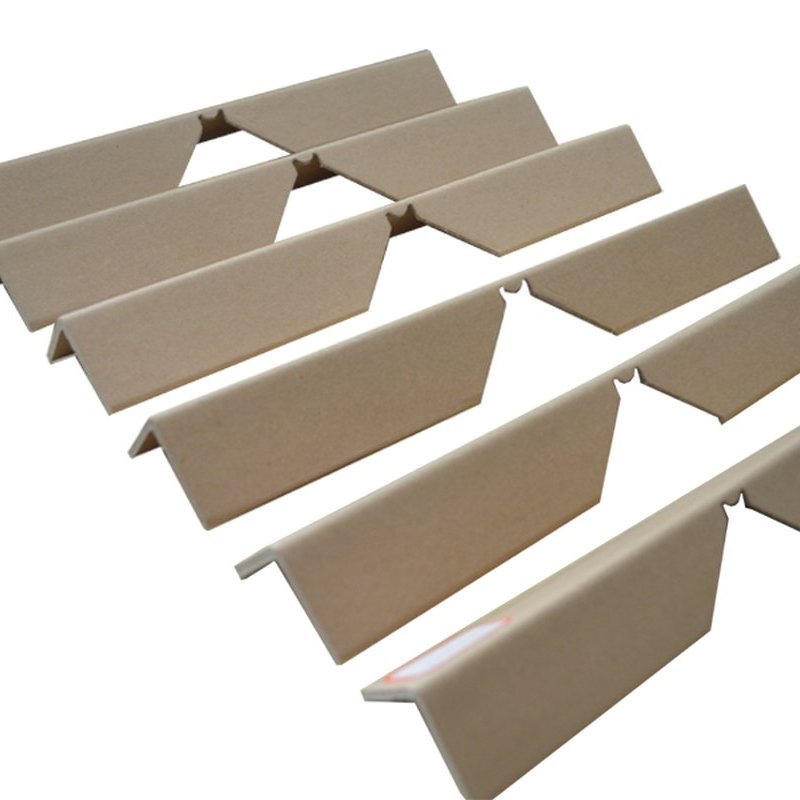
| L-shaped | Two faces at 90° | Corner reinforcement, strap pressure distribution | Palletized cartons, panels, doors, appliances |
| U-shaped | Three faces, open channel | Grips both faces of a panel edge without a strap | Boards, panels, sheet, worktops |
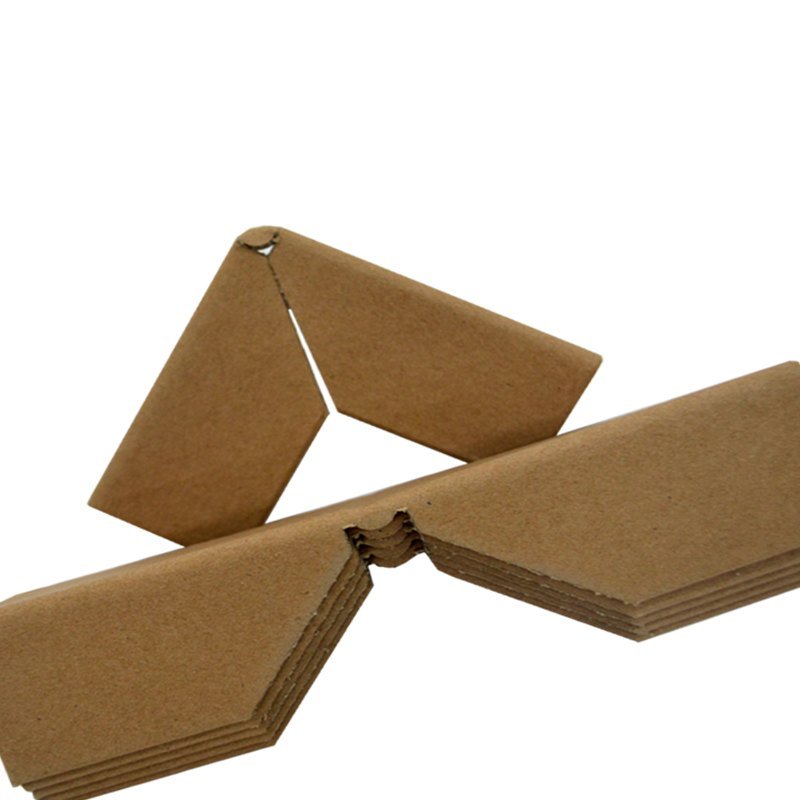
| Bent / notched | U or L section with a cut fold line | Following a corner or a curve without a joint | Shaped panels, frames, irregular packs |
| Flat strip | Single board | Layer separation, surface protection, strap separation | Stacked sheets, panels, printed boards |
| Circular / ring | Closed or part-ring profile | Protecting a round edge or a coil face | Coils, rolls, drums, round table tops |
| Printed | Any of the above, printed | Identification or brand on the pack, not on the product | Retail-bound industrial packs |
The quickest way to specify is to start from the contact that causes the damage, then read across to the profile.
An L-profile on the four vertical corners is the standard answer. The leg width has to be wider than the strap and long enough to spread tension over the carton face. Where the pallet is also wrapped, the protector doubles as the corner the film wraps against. See the L-shaped paper corner protectors.
A U-profile covers both faces and the edge, so it grips the panel without a strap and stays in place while the pack is turned. It is the right choice for boards, panels, worktops and sheet that are handled by the edge. See the U-shaped paper corner protectors.
A straight L cannot follow a chamfer, a radius or a moulded frame without standing off the surface. A notched, bendable profile folds along a prepared line so it can turn a corner or follow an arc and still sit flat. See the bent-type paper corner protectors.
When sheets, panels or printed boards are stacked, the risk is not the outer corner but the interface between one layer and the next. A flat strip separates them, spreads the load and protects the surface from the layer above. It is also the cheapest way to keep a strap off a finished face. See the flat paper corner protectors.
Coils, rolls and drums need protection that follows a circumference rather than a straight edge. A circular profile protects the coil face and the outer wrap; a bendable strip can be run around a large diameter. See the circular paper corner protectors.
The leg is the part of the profile that lies against the product face. Its width sets two things at once: how much surface takes the strap load, and how well the piece stays in place during handling.
A leg that is too short concentrates load near the corner and tends to tip off when the pack is turned. A leg that is too long bridges across recesses, pallet overhangs or hardware, creases at the bridge, and lifts away from the surface. The right leg is the longest one that still lies flat on the packed product — not the longest one available. Asymmetrical profiles, where the two legs differ, suit a pack with one finished face and one hidden face.
Thickness is the most misunderstood number in the specification, because it is often treated as a strength rating. It is not. Thickness resists local indentation, and beyond that the board behaviour depends on paper grade, lamination, moisture content and the geometry of the pack.
Thin board follows curves and folds easily, and suits light cartons, short routes and edges that only need separation.
Medium board is the working range for palletized cartons and panel edges, where the strap has to be spread and the corner kept square.
Heavy board suits repeated handling, heavy loads and edge-stacked panels, and is usually pre-formed rather than folded on the line.
A thicker board also changes the outside dimensions of the pack, typically by a few millimetres per side. On a container loading plan, that difference is multiplied across the load and is worth checking before the carton size is fixed. The wall thickness guide sets out how the wall is built from laminated plies.
Length follows the edge, but the useful question is which part of the edge. A full-height piece protects a vertical pallet corner through its whole height and is the default for export loads. A short piece protects a specific strap position or a local contact point and uses less material.
Where a pack has a pallet overhang, a top cap or a strapping pattern that crosses at an angle, the protector should stop short of those features. A piece that interferes with the cap is usually cut down on site, and a cut piece loses the square end that made it fit.
There is no table that maps kilograms to millimetres, and a supplier who offers one is simplifying past the point of usefulness. What can be structured is the decision itself.
What carries the load? If the carton walls carry it, the protector job is to prevent local failure at the strap line. If the product itself carries it — panels stacked on edge, for example — the protector is a load path and needs more board.
How many times will it be handled? A domestic pallet with two transfers tolerates less board than an export pallet with six.
What is the pallet footprint relative to height? A tall narrow stack leans, and the corner protector is part of what keeps it straight; a low wide stack rarely needs the same.
What has failed before? A damage photo tells you whether you are solving compression, impact or abrasion, and those three do not take the same profile.
Compression behaviour of a paper profile is a function of the whole construction, so the practical approach is to evaluate the proposed product on the actual pack rather than to compare catalogue numbers.
Ask what the number means. A compression or bending figure is only comparable if the test method, the specimen size and the conditioning are stated. If they are not, treat the figure as marketing.
Test the interface, not the board. Strap the real pallet with the candidate profile and inspect the strap line after handling, not just after packing.
Check consistency across the order. The second shipment should match the approved sample in thickness, leg width, length, fold quality and surface. Ask how that is checked and what record you will receive.
Agree the acceptance criteria in writing. Dimensions and tolerances, surface condition, print position and the sample reference should all appear on the quotation.
Paper takes on moisture from the air and from contact with damp surfaces. In a container, that means a protector fitted dry can still absorb water during a long sea leg, and a damp protector is a softer protector — it loses stiffness exactly where the strap needs it.
Three practical controls matter more than any coating claim: fit the protectors dry, store them off a concrete floor and keep them wrapped until use, and do not lay them against wet timber or a wet pallet deck. Where the route is long or the cargo is moisture-sensitive, a coated board can be discussed with the supplier, but the storage discipline comes first.
A quotation request that produces comparable answers contains six things.
| Item | What to send | Why the supplier needs it |
|---|---|---|
| Profile and dimensions | A × B leg widths, thickness T, cut length L, in millimetres | Defines the product; without it the price is for something else |
| Application | Cargo type, weight, pallet size, strapping or wrapping method | Drives paper grade and thickness recommendation |
| Pack format | Bundle count, carton or pallet packing, labelling | Changes handling cost and freight volume |
| Quantity | Pieces or metres per order, and expected annual volume | Sets the production run and the price band |
| Route | Destination country, transport mode, expected transit time | Affects moisture and packing decisions |
| Acceptance | Tolerances, sample requirement, print artwork, inspection method | Prevents a dispute at delivery |
Adding a photo of the packed pallet and, if available, a photo of previous damage will usually save one round of questions. For supplier-side evaluation criteria — factory capability, sampling, production planning and landed cost — the guide to paper edge protector manufacturers in China covers that side of the decision.
Specifying the product instead of the packed load. Measuring the panel rather than the panel plus its wrap and corner radius is the single most common cause of a protector that does not fit.
Buying on thickness alone. Two 5 mm boards from different mills can behave differently; the grade and lamination are part of the specification.
Ignoring the strap position. A protector that the strap misses entirely is decoration. Mark the strap lines on the pack before choosing the leg width.
Forgetting the pallet deck. The bottom edge carries the whole stack and is often the only unprotected edge on the pallet.
Changing strap tension after approval. The sample was approved at one tension; production at a higher tension changes the load path. Comparing unit price across order units has the same effect — per piece, per metre and per bundle are not interchangeable.
Custom work is often the only route that works: a section that is not a right angle, a leg that has to clear a feature on the product, or a print that has to register to the fold rather than the sheet. Because the profiles are formed from laminated board rather than moulded, customisation is usually cutting and notching rather than new tooling, which keeps the entry cost lower than buyers expect. The custom paper angle board process shows how a drawing becomes a sample and then a run; printed versions are covered under printing paper corner protectors.
Hengnice has 16 years of experience in this product category, eight production lines, a factory of approximately 4,500 square metres and a daily output of around two 40HQ containers. Custom sizes, printing, OEM and ODM work, product development, quality inspection and export packaging are all handled in-house, which is what makes a non-standard notch a production question rather than a project.
An L covers two faces and needs a strap or a hand to hold it. A U covers both faces and the edge, so it grips the panel on its own. Panels, boards and profiles usually take a U; corners of cartons and pallets usually take an L.
50 × 50 mm is a common market reference, but it should be checked against the strap width and the carton face. A wider leg spreads more load; a leg that bridges a recess will crease.
Sometimes, if the products are similar in thickness and the fit only needs to be approximate. Once the thickness range spans more than a few millimetres, two sizes give a better result than one compromise size.
For a repeat pack, yes. A sample costs a fraction of a replacement shipment and is the only way to confirm the fit on the actual product. Ask for the sample to be produced on the same line and from the same board as production.
Dimensionally: leg widths, thickness, cut length, fold or notch position, surface and print. Where compression or bending performance matters, it is checked against an agreed method on the approved sample rather than inferred from a catalogue figure.
The four dimensions, the packed load description, the strapping method and the destination. Everything else can be discussed; without those four, any price is provisional.
Send the profile, the dimensions, the packed load details, the strapping method and the destination to mona@hengnicepacking.com, and the reply can be a specification rather than a product list. Buyers who want to see the range first can start from the paper corner protector category, or send the requirement through the contact form.
