

Paper edge protectors are rigid paper profiles, usually L-shaped, that sit between a load and whatever touches it — a strap, a pallet deck, another carton, or the wall of a container. They work by converting a line of contact into a band of contact. That single change is why a strapped pallet arrives with square corners instead of crushed ones.
Damage in transit is rarely caused by one dramatic event. It accumulates: a strap tensioned against a bare carton edge, a corner resting on a pallet deck, a stack settling overnight, a forklift pushing a load against a container wall. Each of these is a pressure problem, and pressure is force divided by area. Paper edge protectors do not reduce the force. They increase the area, and that is enough to keep most industrial loads intact.
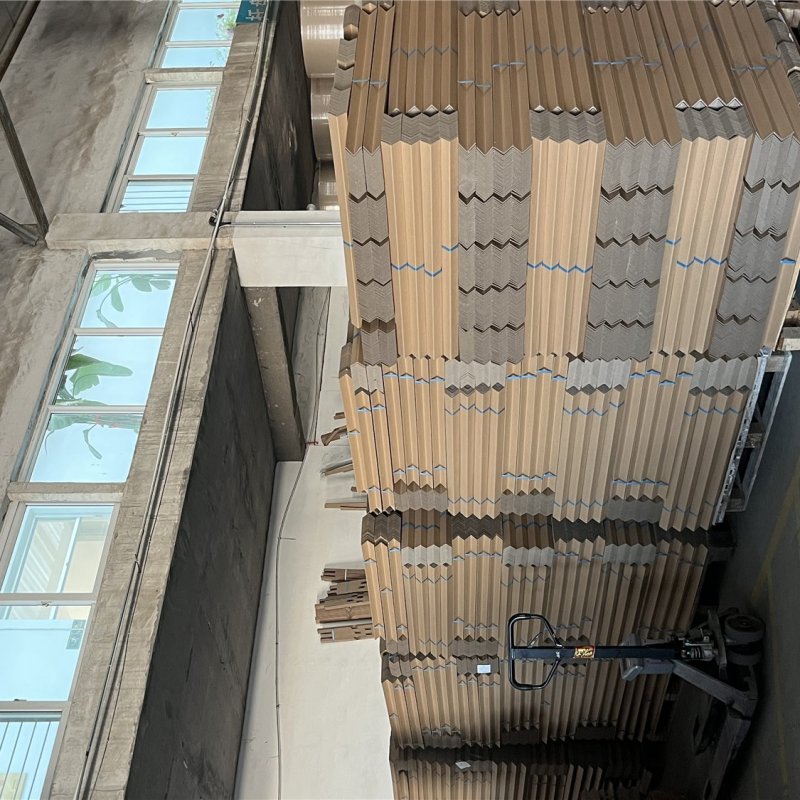
A corrugated carton, a panel, a door leaf or an appliance cabinet is strongest across its faces and weakest at its edges. The edge is where the board structure ends, where there is no continuous surface to spread a load, and where the finished face is most exposed.
Compression. A strap tightened around a pallet concentrates its tension on the vertical edges. Without an interface, the carton wall deforms inward at that line, the stack settles, and the wrap that was tight on day one is loose on arrival.
Impact. A corner takes the first contact when a load is set down, tipped, or pushed against a container wall. Because the corner is small, the force per unit area is high and the board crushes locally.
Abrasion. Vibration over a road leg or a sea passage rubs the load against the pallet, the film, or the carton beside it. This is the mechanism that produces scuffed furniture edges and marked appliance panels without any visible impact at all.
These three are often confused in damage reports. A crushed corner is usually compression; a split carton corner is impact; a scuffed face edge is abrasion. The right protector depends on which one you actually have, which is why a damage photo is more useful to a supplier than a specification alone.
An L-profile covers two adjacent faces of a corner. When a strap crosses it, the strap tension is transferred through the paper into a strip of the carton face rather than into a single vertical line. The protector also holds the corner at a fixed geometry, so the two faces cannot fold toward each other under load.
Two properties make this work. The first is the leg width: a wider leg spreads the same strap tension over more board. The second is board thickness, which resists local indentation where the strap crosses. Neither property is a strength rating on its own — paper grade, lamination and moisture content all contribute — but together they decide whether the strap marks the carton or merely holds it.
It does not increase the compression strength of the carton itself, and it does not replace correct stacking. A pallet that is overloaded at the bottom layer will still fail. The protector manages the interface between the load and the securing material; it is not a structural member of the carton.
| Securing method | What it does to the edge | What the protector changes |
|---|---|---|
| PET or PP strapping | High point load along the strap line | Spreads tension across the leg width and stops cut-in |
| Stretch film | Low pressure but continuous, can abrade | Provides a smooth, rigid corner for the film to wrap against |
| Corner boards plus film | Film tension pulls corners inward | Keeps corner geometry square while the film relaxes |
| Pallet deck contact | The bottom edge carries the whole stack | Distributes that load along the full protector length |
The combination matters more than any single component. Strapping without an edge interface is the most common cause of cut-in. Film without corner boards allows a wrapped pallet to lean as the film relaxes. Edge protectors are the interface that lets the other two do their job.
The pattern is consistent: any product with a finished surface, a fragile edge, or a heavy concentrated load benefits. Furniture and cabinet panels need edge protection because a chipped banded edge cannot be repaired invisibly. Appliances need protection against both impact and abrasion on painted steel. Glass and stone need the load spread and the edge kept away from hard contact. Metal profiles and coils need protection from strap pressure and from each other. Building materials such as boards, doors and cladding need protection that survives being stacked on edge.
Export packaging adds a further requirement: the protection has to survive more handling events than a domestic shipment, and it has to be consistent, because a claim on one pallet out of fifty is still a claim.
Four dimensions define an L-profile: leg width A, leg width B, thickness T and cut length L. Beyond those, the paper grade and surface finish are agreed with the supplier against the cargo and the route. The angle board dimension guide explains how the four numbers are written on a quotation.
Leg width should be long enough to spread the strap load, and short enough not to bridge across a feature of the pack such as a recessed panel, a pallet overhang, or a cap. A leg that bridges will crease at the bridge instead of lying flat, and a crease is where the protector fails.
Thickness resists indentation at the strap line and local crushing at the corner. Heavier loads and repeated handling call for more board; light cartons on a short domestic route do not. Because a thicker board also changes the pack dimensions by a few millimetres per side, thickness should be agreed before the carton size is frozen. The wall thickness guide covers the selection logic in detail.
A full-height piece protects a vertical pallet corner along its whole height. Shorter pieces protect specific strap positions or local contact points and use less material. Both are valid; mixing them on one pallet usually means the full-height corners are doing the work and the short pieces are decorative.
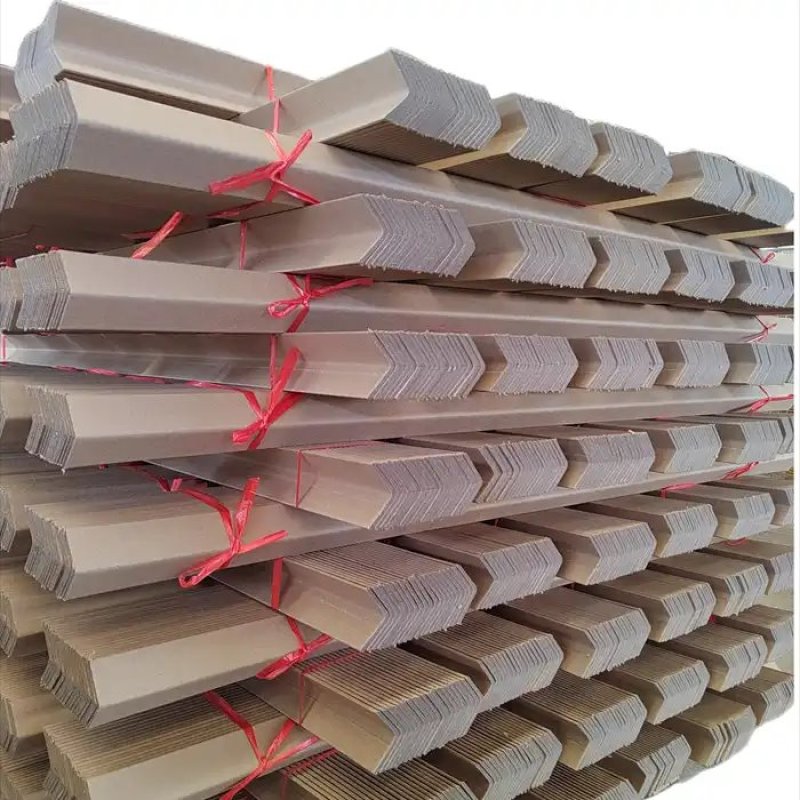
Three things separate an export pack from a domestic one: duration, handling count and humidity. A container can spend weeks in transit, moving between climates, and the paper in the pack absorbs and releases moisture along the way. Protectors should be dry when fitted, stored off a concrete floor, and kept wrapped until they are used.
Handling count matters because each transfer is another chance for the corner to take a knock. A pallet that is loaded, lashed, driven, lifted and unloaded has five interfaces with the outside world; a protector placed only at the top corners addresses one of them.
Destination requirements also enter the specification. Where a buyer asks for paper-based packaging, an edge protector is one of the easier components to justify, provided the claim made for it is accurate and the supplier can state the material and grade on the quotation.
Consider a furniture factory shipping cabinet doors on edge, twenty-four per pallet, banded and wrapped. Without protection, the two vertical pallet corners take the band tension directly, and the bottom door of each stack carries the load of the ones above on its edge.
A workable arrangement is straightforward. Full-height L-profiles on all four vertical corners, positioned so the band crosses the middle of the leg rather than its outer edge. A flat protector strip under the bottom layer to separate the doors from the pallet deck. Strapping applied after the corners are in place, then stretch film over the whole pallet. The result is not a stronger door — it is a door whose edge never becomes the load path.
Where the doors have a shaped or chamfered corner, a bendable profile can follow the shape rather than standing off it. That is a detail worth raising at the sampling stage rather than after the first container.
They change how force is transferred. A strap tightened over a bare carton edge concentrates load on a narrow line and deforms it; the same strap over an L-profile spreads that load across the leg width. The effect is visible at the strap line and at the corner when the pallet is unpacked.
Yes, and that is their most common use. They matter more with high-tension PET strapping than with light PP strapping, because the higher the tension, the more the strap will cut into a bare edge.
There is no universal figure. Thickness is chosen against load weight, strap tension, corner geometry and how many times the pallet will be handled, and it should be confirmed on a sample of the actual pack. A supplier who quotes a thickness without asking those questions is guessing.
Yes. The protector gives the film a square, rigid corner to wrap against, which helps the load hold its shape as the film relaxes. Film alone tends to pull an unprotected corner inward.
Both leg widths, thickness, cut length, quantity, cargo weight, strapping method, the damage you are trying to prevent, and the destination country. A photo of the packed pallet or of previous damage removes most of the remaining uncertainty.
For a light pack on a short route, often yes. Once a protector has been compressed at the strap line or creased at a corner, its ability to spread load again is reduced, so reuse should be a decision made per pack rather than assumed.
The most useful first step is not a product list but a description of the pack: what is inside, how heavy it is, how it is secured, how far it travels and what has gone wrong before. That description is what turns a catalogue item into a specification.
Hengnice has manufactured paper edge protectors for 16 years, with eight production lines and a factory of approximately 4,500 square metres, producing around two 40HQ containers per day. The company supplies L-shaped, bendable, flat, circular and corrugated profiles, with custom sizes, printing, OEM and ODM work supported from design through quality inspection and export packing.
To discuss a specific application, send the pallet dimensions, load weight, strapping method and destination to mona@hengnicepacking.com, or review the paper corner protector range and the L-shaped paper corner protectors used for pallet work.
