

Paper edge protectors are compared with foam, plastic and timber on five criteria that actually decide an export pack: cost per protected edge, the type of damage each material prevents, what happens to it at the destination, how it behaves when wet, and whether it carries a customs obligation. Strength alone rarely settles the choice, because all four materials can spread a strap load adequately on a normal pallet.
The comparison below is written from the point of view of a packaging engineer specifying a repeat export pack, not a one-off shipment. That matters: the deciding factors on a repeat pack are consistency and the cost of the unpacking step, not the peak performance of a single sample.
The four options are not interchangeable, because they solve different parts of the same problem. Paper and timber resist compression and spread a strap load. Foam absorbs impact energy. Plastic recovers and survives water. Reading across from the failure you have is faster than comparing specifications.
| Material | Best at | Weak at | Typical position |
|---|---|---|---|
| Paper board (L, U, ring) | Spreading strap load, holding corner geometry, edge coverage | Wet conditions, repeated impact, reuse | Pallet corners, panel edges, coil rims |
| Foam (PE, EPE, PU) | Absorbing impact, cushioning a fragile surface | Carrying a sustained load, holding shape under a strap | Around the product, inside a carton |
| Plastic (corner caps, extrusions) | Water resistance, reuse, impact recovery | Cost per unit, separate waste stream, static | Wet routes, returnable racks |
| Timber (corner boards, crates) | Structural support, very heavy loads | Weight, cost, ISPM 15 treatment where applicable | Crates, heavy machinery, blocking |
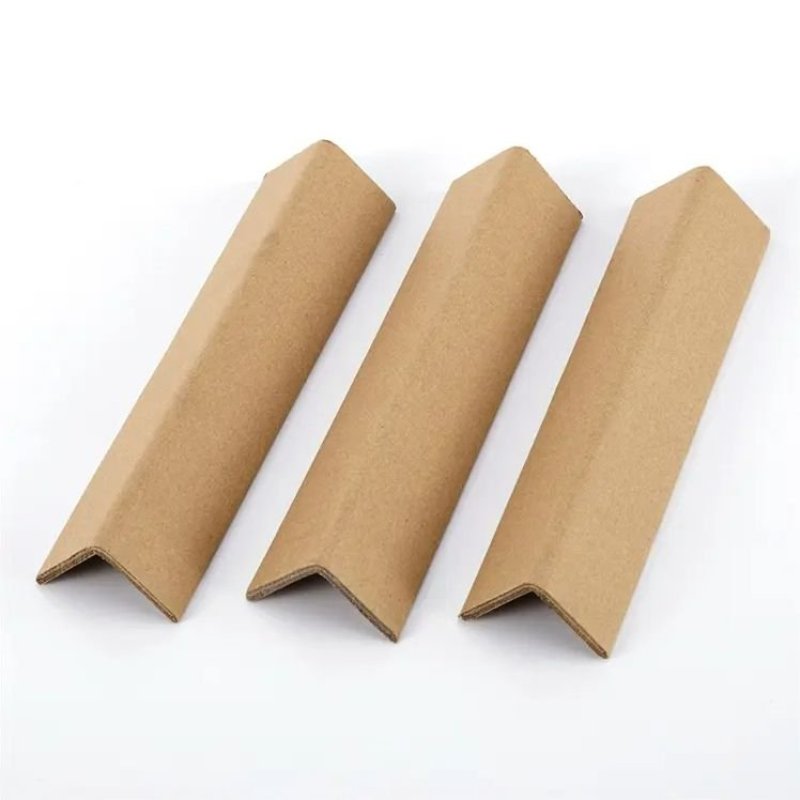
Paper wins on three counts in a normal export pack. It is the cheapest way to cover a linear metre of edge, because the profile is cut from laminated board rather than moulded. It holds a corner square while film relaxes, which foam does not. And it goes into the same waste stream as the cartons and the wrap, so unpacking does not need a second bin or a second instruction to the warehouse team.
It loses on water, on reuse and on repeated hard impact. A wet board softens and can mark a finished surface. A board that has been compressed at the strap line does not recover the way plastic does. And a hard strike leaves a permanent set.
That is why most export packs mix materials rather than standardising on one. Paper at the edges and corners, foam where a fragile surface needs cushioning, plastic only where the pack actually meets water, and timber where the load needs structure.
Solid wood packaging used in international trade is subject to phytosanitary requirements in many markets, which is why timber corner boards and crates are usually marked under a wood packaging programme. Paper-based edge protection is not solid wood packaging and does not carry that obligation.
The practical consequence is at packing: a factory that adds a timber board inside a crate to protect a corner also adds a component that has to be treated and marked. Substituting a paper profile where the board is not structural removes that step.
The limit is honest and worth stating plainly: where the board is carrying load rather than protecting a surface, timber or steel stays. A paper profile is a liner, not a structural member.
Not per piece. The comparable unit is cost per metre of protected edge, and it has three parts: the component, the labour to fit it, and the freight volume it adds.
| Cost element | Paper | Foam | Plastic | Timber |
|---|---|---|---|---|
| Component per metre | Low | Medium | High | Medium to high |
| Fitting time | Seconds, no adhesive | Tape or wrap needed | Push on | Nailing or banding |
| Freight volume added | Low, bundles flat | High, bulky | Medium | High, heavy |
| Treatment or marking | None | None | None | Where applicable |
| Disposal at destination | Paper stream | Plastic stream | Plastic stream | Wood or general |
Two of those rows are usually ignored and both change the answer. Fitting time is a real line cost on a high-volume pack, and freight volume decides what a container actually holds. A cheaper component that adds 15 mm to each pallet can cost more in loading than it saves in purchase price.
The fastest route to a specification is to name the failure you are trying to stop, then read across.
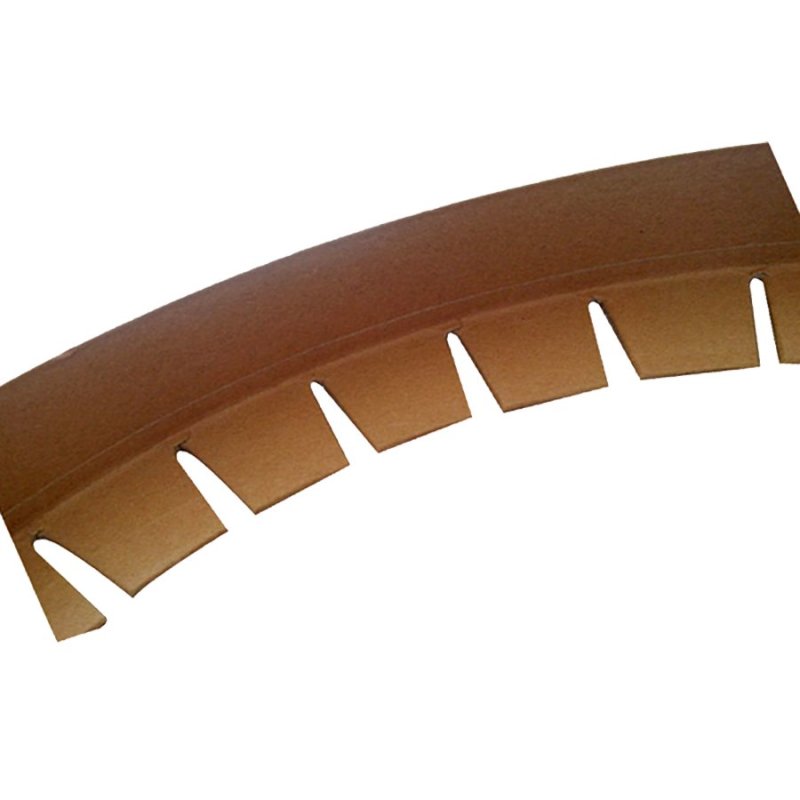
Most of the value comes from separating the interface from the structure. The structure — pallet, crate, blocking — is decided once and does not change. The interface is where damage actually starts, and it is the part worth optimising, because it is cheap, it is cut to size, and it can be changed without re-engineering the pack.
Hengnice has manufactured paper edge protection for 16 years, with eight production lines in a factory of approximately 4,500 square metres and a daily output of around 200,000 metres. L-shaped profiles run from 2.5 mm to 8 mm wall with legs of 25-100 mm and cut lengths up to 6,000 mm, and the same board is used for U, bent, flat and circular profiles, so a mixed pack can be specified in one order rather than four.
For spreading a strap load and holding a corner, yes. Plastic recovers better from repeated impact and survives water, which paper does not.
No. Foam absorbs impact but collapses under sustained strap tension, so it does not prevent cut-in. The two solve different failures.
No phytosanitary marking applies, because it is not solid wood packaging. That is one reason it is used inside crates.
Paper, for edge coverage, once fitting time and freight volume are included. Foam is often cheaper per unit but bulkier to ship and slower to fit.
Yes, and that is the usual arrangement: paper at the edges, foam at fragile surfaces, plastic only where water is a risk.
The product, its weight, how it is secured, the route and what has failed before. With those, the material question usually answers itself.
Send the pack details — product, weight, strapping method, route and previous damage — to mona@hengnicepacking.com and the reply can be a material recommendation with a cost per protected edge rather than a price list. The paper corner protector range covers the L, U, bent, flat and circular profiles referred to above, and the wall thickness guide explains how the board grade is chosen.
