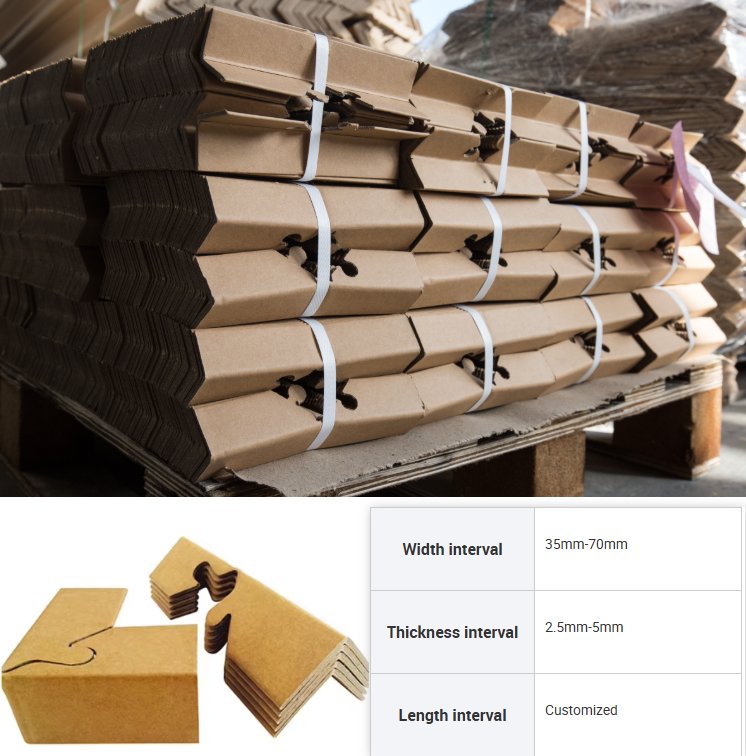
Latch-type paper corner protection strip is supplied as a continuous length rather than as pre-cut corner pieces, with a latch cut at intervals along the leg so the strip closes and stays closed around a panel edge. Where a corner protector covers 400 mm of one carton, a strip covers the full two-metre edge of a door, a panel bundle or an appliance cabinet in one pass. Width 35-70 mm, thickness 2.5-5 mm, any length.
What Is a Latch-Type Paper Corner Protection Strip?
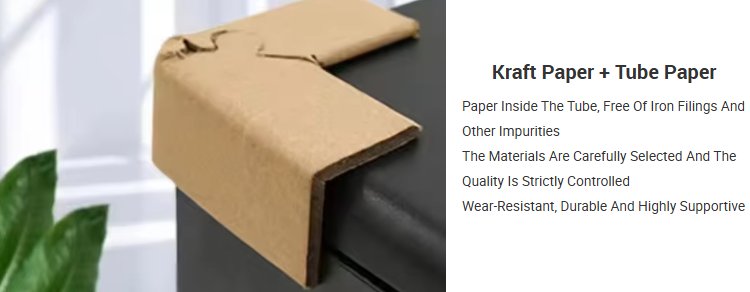
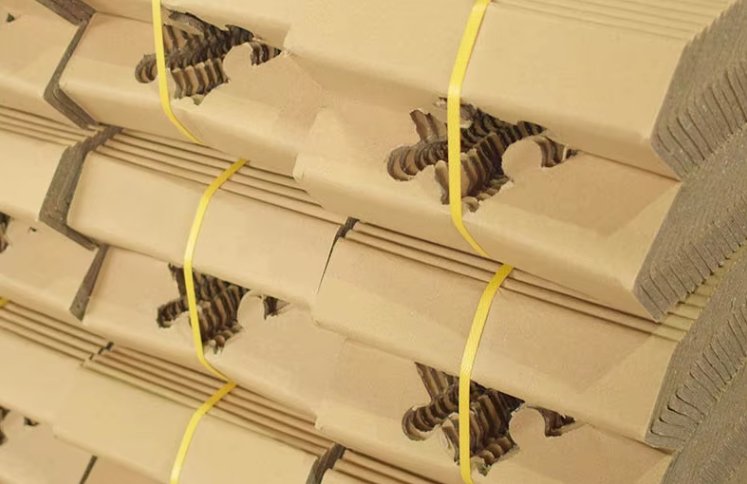
It is the same laminated kraft angle board as any other edge protector, with two differences. First, the latch: a cut tab and a matching slot spaced along the length, so the strip locks itself closed once it is folded over the edge. Second, the format: it ships as a running length, not as a fixed 400 mm piece, so one coil covers every edge on a panel line.
That format answers a practical problem. On long edges - a 2.4 m door, a 3 m aluminium extrusion, a 1.8 m appliance cabinet - four pre-cut corners leave the middle of the edge bare, which is exactly where a strap or a fork tine lands. A strip runs the whole way, and the latch stops it springing open between the packing station and the pallet.
How the latch differs from a corner lock
A corner lock closes a short board around a 90 degree corner and holds two faces. A latch on a strip closes the profile at intervals along its length, so a single strip behaves like a continuous channel rather than a series of separate pieces. In practice the latch spacing is the specification that matters: too far apart and the strip gaps open on a curved or uneven edge, too close and the die wastes paper and slows the cut.
Latch-Type Paper Corner Protection Strip Specifications
| Profile | L profile with latch cut, supplied as a continuous strip |
| Material | Kraft paper, roll paper, eco-friendly glue |
| Leg width | 35-70 mm, customizable |
| Thickness | 2.5-5 mm, customizable |
| Length | Any length, supplied in coils or in cut strips |
| Latch spacing | Set to your edge length, typically 200-400 mm |
| Incision | Cut to your requirement, latch pattern on a dedicated die |
| Colour and print | White or kraft brown, logo and text printable |
| MOQ | 500 meters |
| Daily output | 200,000 meters |
| Lead time | Shipment within 7 days of deposit |
| OEM and ODM | Available, including latch spacing and print |
Strip, Latch Lock or Plain Angle Board
| Point | Latch-type strip | Plain angle board |
| Coverage on a long edge | Continuous, no gaps in the middle | Piece by piece, gaps between |
| Holds itself closed | Yes, at every latch | No, needs tape or strap |
| Cutting at the line | Cut to any length from a coil | Only the lengths you ordered |
| Best for | Doors, panels, extrusions, appliance cabinets | Carton corners, mixed pallets |
How to Fit a Latch-Type Strip
- Cut to length - pull the strip from the coil and cut it 30-50 mm longer than the edge, so it overhangs at both ends.
- Fold and close - run the fold line along the edge and press the latch tabs into their slots, working from one end so the profile does not twist.
- Space the latches - if the strip is longer than the spacing, close every latch. On an uneven or curved edge, close two latches before moving on.
- Strap or film over it - the strip is designed to be strapped over, not strapped around, so the strap crosses paper rather than the product.
Worked example: 2,400 mm door edges, two vertical edges per door, PET strapping at 600 mm and 1,800 mm. Specification: 50 mm legs, 3 mm thick, latch spacing 300 mm, supplied in 2,450 mm cut strips, natural kraft, 6,000 meters.
Where Latch-Type Strips Are Used
- Doors and door frames - full-height edge coverage with no bare middle
- Furniture panels and flat-pack - protects the long edge that a strap crosses
- Aluminium and plastic extrusions - a continuous guard on a 3 m length
- Appliance cabinets - side and top edges where the carton rests on the unit
- Glass and mirror crates - a strip that stays closed while the crate is tilted
- Panel bundles - one coil covers a whole bundle instead of eight separate corners
Printing, Latch Spacing and Custom Build
Printing is one or two colours on white or kraft base, and because the strip is continuous, a repeating logo along the length is practical - it reads as a tape rather than a label. Latch spacing is the custom element: send the edge lengths you pack and we set the spacing so that no edge ends mid-latch.
Two things to send with an enquiry: the edge length range and the strap positions. From those we return a latch drawing and a sample strip, so the spacing is proven on your own panel before the coil is run.
Frequently Asked Questions
Q: What is a latch-type paper corner protection strip?
A: It is a kraft L profile supplied as a continuous length with latch tabs cut along the leg, so it closes and holds itself around a long panel edge instead of being taped on.
Q: How is it different from a corner protector?
A: A corner protector is a short pre-cut piece for a carton corner. A strip runs the full length of an edge, which is what doors, panels and extrusions need.
Q: Can I choose the latch spacing?
A: Yes. Send the edge lengths you pack and we set the spacing so each edge finishes cleanly, typically 200-400 mm apart.
Q: Is the strip recyclable?
A: Yes, kraft paper with eco-friendly glue and no plastic, so it recycles with the cartons and panels.
Q: Can it be printed along the length?
A: Yes, a repeating logo or message in one or two colours on white or kraft base.
Q: What thickness for steel strapping?
A: 4-5 mm. For PET or PP strapping on panels and doors, 3-4 mm is the working range.
Q: What is the MOQ?
A: 500 meters, which is roughly 200 door edges, so a trial is realistic.
Q: How fast do you ship?
A: Within 7 days of deposit for standard specifications; a new latch die is quoted with the first order.
Request a Latch-Type Strip Quote
Send the edge length range, the strap positions, the leg width and thickness, and the quantity in meters. We return the price, a latch drawing and the delivery date. Email mona@hengnicepacking.com with the subject line latch-type paper corner protection strip plus your edge length.


