Honeycomb cardboard is a sandwich board built from two kraft facing sheets bonded to an expanded hexagonal paper core. That structure is what makes it useful: a 20 mm honeycomb sheet carries compression load with a fraction of the weight of plywood or solid board, and it does it with paper and glue only, so the whole panel recycles in the normal cardboard stream. Thickness from 10 mm upward in 5 mm steps, width up to 1.25 m, length cut to order.
What Is Honeycomb Cardboard Made Of?
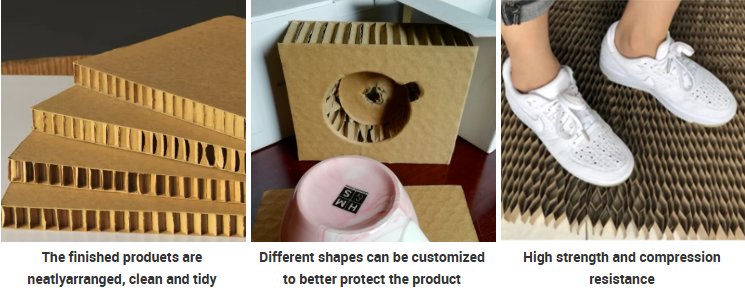
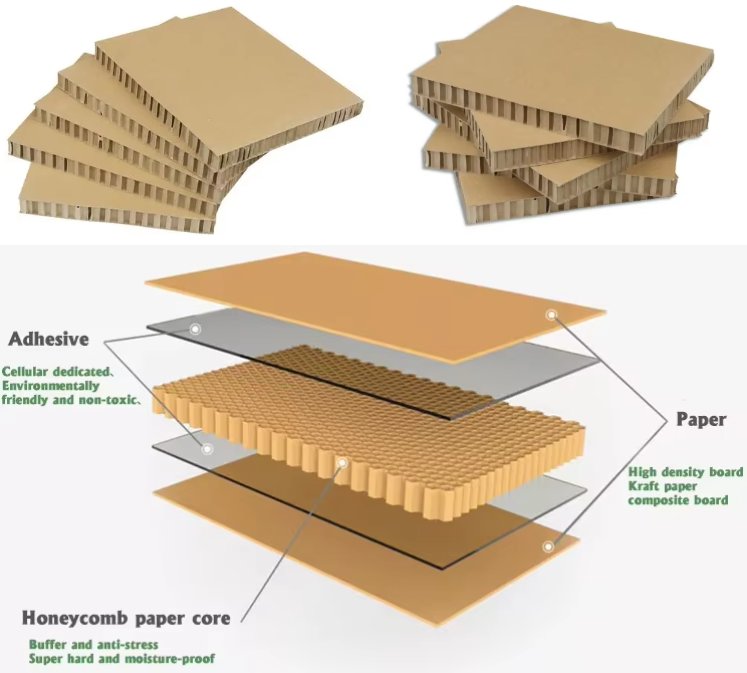
Three layers, and only three. The upper and lower faces are kraft paper. The middle is an expanded paper honeycomb core, glued to both faces with an eco-friendly adhesive. Nothing else is added: no wood, no foam, no plastic film. The cell walls run vertically between the facings, which is why the panel resists compression across its thickness far better than the paper weight suggests.
The facings are laminate paper in 130 g, 160 g, 200 g or 250 g composite grades - kraft paper with an inner layer of sand tube paper - and the core paper is generally 110 g. Increasing the facing weight raises surface strength and print quality; increasing the core weight or reducing the cell edge size raises compression strength. Buyers specify both, because two boards of the same thickness can behave very differently.
Why the edge size matters more than the thickness
The honeycomb edge is measured in 4, 6, 8 and 10, and the smaller the edge the stronger the compression. A finer cell means more walls per square metre, so the load is shared across more paper. A 6 mm edge board at 20 mm thickness can outperform a 10 mm edge board at 25 mm on flat crush, at the same or lower weight. That is the single most useful thing to know when comparing quotes from two suppliers.
Honeycomb Cardboard Specifications
| Type | Honeycomb cardboard, paper honeycomb sandwich board |
| Surface paper | Kraft paper or customized, coated both sides |
| Laminate paper | 130 g, 160 g, 200 g, 250 g composite, kraft with sand tube paper inner layer |
| Core paper | Honeycomb core paper, generally 110 g |
| Cell edge | 4, 6, 8 or 10, smaller edge equals higher compression strength |
| Thickness | 10 mm minimum, then 15, 20, 25, 30 mm in 5 mm steps, customized |
| Width and length | Width generally within 1.25 m, length cut to customer requirement |
| Pulp and process | Wood pulp, mechanical pulping, composite paper |
| Printing | Printable text pattern, white or kraft background, logo on request |
| Features | Lightweight, compressive, durable, 100 percent paper |
| Supply ability | 100,000 square meters per day |
| OEM and ODM | Available, including size, thickness and print |
Honeycomb Board vs Plywood, Solid Board and Corrugated
| Point | Honeycomb cardboard | Plywood / solid board |
| Weight at equal thickness | Lowest of the three | Three to five times heavier |
| Export treatment | No wood, so no ISPM 15 stamp and no fumigation | Heat treatment or stamping required |
| End of life | Repulps with cardboard | Separate wood waste stream |
| Point load | Needs edge protection on cut faces | Higher local resistance |
Against corrugated, the difference is thickness and span. Corrugated wins on thin panels and printed retail boxes. Honeycomb wins the moment the board has to carry load across a span, sit under a pallet, or replace a timber deck board.
Where Honeycomb Cardboard Is Used
- Electronic equipment packaging - cradles and base pads that hold a unit without foam
- Steel and aluminium coil outer packaging - edge and face protection on coils where wood is not wanted
- Pallet deck boards and layer pads - spreads load between layers and replaces timber boards
- Food packaging backing board - rigid backing where a printable food-grade facing is needed
- Building site protection - temporary floor and surface protection that can be swept up and recycled
- Handwork and display - cut shapes for stands, dividers and props
Cutting, Printing and Custom Sizes
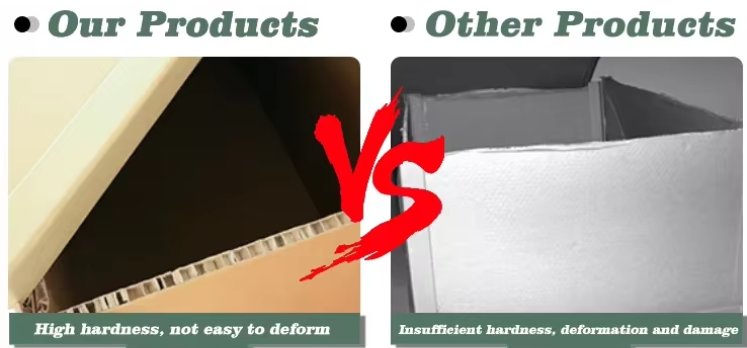
Boards are supplied as full sheets or cut to size, and because the core is paper, cutting is fast: a knife, a saw or a die. The usual caution is the cut edge - an exposed honeycomb face compresses more easily than a faced one, so on load-bearing panels the cut edge should either be wrapped or kept outside the contact area.
Printing is available on the kraft or white facing, either a text pattern or a logo, in one or two colours. Because the facing is a flat continuous sheet, print quality is good, and the panel doubles as a branded base pad inside the carton.
Frequently Asked Questions
Q: What is honeycomb cardboard?
A: It is a paper sandwich board: two kraft facings glued to an expanded hexagonal paper core, used as a lightweight structural panel for packaging, pallets and protection.
Q: How strong is it compared with plywood?
A: At equal thickness it carries less point load but more than enough distributed load for packaging, pallets and base pads, at a fraction of the weight, and it needs no ISPM 15 treatment for export.
Q: What thickness can I order?
A: From 10 mm, then 15, 20, 25 and 30 mm in 5 mm steps. Larger thicknesses are quoted per project.
Q: What is the maximum sheet size?
A: Width is generally within 1.25 m and length is cut to your requirement, so long pads and deck boards are normal.
Q: What does the edge number mean?
A: It is the honeycomb cell edge in millimetres. 4 gives the highest compression strength, 10 the lowest, at the same thickness and paper weight.
Q: Is it recyclable?
A: Yes. Paper facings, paper core and eco-friendly adhesive, so the whole board repulps with ordinary cardboard.
Q: Can it be printed and die cut?
A: Yes, one or two colours on kraft or white facing, and die cut to a shape such as a cradle or a divider.
Q: What is the supply capacity?
A: 100,000 square meters per day, so trial orders and repeat programs run on the same line.
Request a Honeycomb Cardboard Quote
Send the sheet size or cut size, the thickness, the cell edge you need and the total quantity in square meters, plus whether the facing has to be printable. We return the price, a sample board and the delivery date. Email mona@hengnicepacking.com with the subject line honeycomb cardboard plus your thickness.


